Before the Numbers
At a nicotine conference in Switzerland, consensus was already in the room, quietly defining the edges of perception.
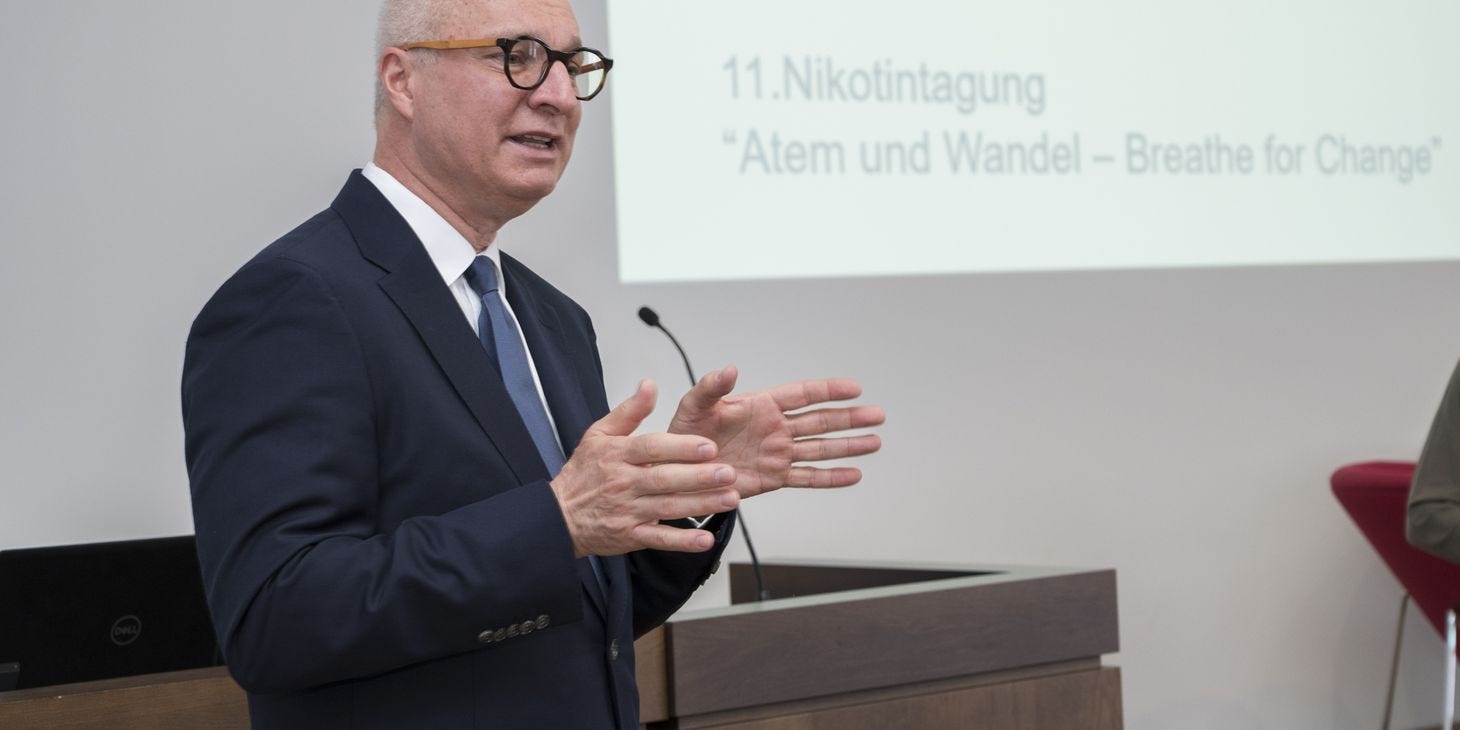
In Barmelweid, the opening address arrived less as an intervention than as the continuation of something already underway. José Luis Castro moved through a familiar repertoire: the protection of youth, caution toward new products, vigilance over a landscape of use and habit in flux. Nothing needed to be argued explicitly. The language rested on a prior recognition, a shared point of departure that no one in the room seemed inclined to question.
That may have been why it passed through the room without friction: the absence of conflict did not signal agreement so much as delimitation—a quiet recognition of what could be said, what need not be defended, and what had already been settled in advance.

The framing did not begin with the speech. It was already embedded in the program. Throughout the day, the themes aligned with minimal deviation: nicotine prevention, smoke-free culture, the industry's language, the impact of new products on children and adolescents, and digital strategies designed to contain their spread.
This kind of organization is hardly unusual in contemporary public-health gatherings, where the convergence of research, advocacy, and policymaking tends to narrow the space for explicit dissent. The language of prevention helps organize action, but it also prefigures the terms of debate.
What emerged was not a confrontation between competing interpretations so much as the reiteration of a shared vocabulary from multiple angles. In that arrangement, the conference functioned less as a site of reflection than as a mechanism of stabilization: before asking how risks, uses, and contexts might be distinguished, it had already determined which distinctions would count as relevant.
Its coherence is derived from that.
And so did its limit.
In this context, Castro’s position ceases to be incidental and becomes part of the arrangement itself. He speaks not from a distance, but from within a role that blends formulation, mobilization, and the defense of agendas. As a WHO Special Envoy, his task is to amplify messages, build alliances, and sustain institutional priorities.
This does not diminish the weight of what he says. But it does change how the speech must be heard. It operates not as an arbitration between competing hypotheses, but as a situated intervention within a broader effort to organize perceptions, align interpretations, and stabilize frameworks in public debate.
To his credit, Castro does not conceal this shift. He says so plainly: policy alone is not enough, because it is often “downstream from culture.” The issue, then, is not that the speech disguises its priorities, but that it relocates the center of gravity of the debate—from differentiating risks to defining the cultural and narrative terms through which those risks will be understood.
At that point, the problem no longer appears solely as one of evidence or scientific uncertainty, but as one of perception: how nicotine is seen, interpreted, and absorbed into the social imagination. Castro marks this shift explicitly when he frames prevention not only as a matter of regulation but also as a matter of understanding “how products are positioned, how language is used, and how perceptions of risk are shaped.”
He goes further. If policy is often “downstream from culture,” then what matters is “the story we are telling in the culture.” In his formulation, the concern is that “the narrative around nicotine is being shaped elsewhere,” in the language of innovation, choice, and harm reduction —and that, if left unchecked, it may “take hold before we have had a chance to define our own.”
With that move, the dispute extends beyond what is known to include which languages are granted legitimacy to describe the problem. The question is no longer only what counts as evidence, but who defines the narrative terrain on which that evidence will be interpreted.
That shift alters the nature of the problem. What once appeared as a question of differentiating risk now operates at the level of authority: who defines categories, who names phenomena, who establishes equivalences.
As that axis shifts, conceptual precision no longer occupies the center of the scene. Distinct products begin to circulate under a shared designation, sharing language before they share properties.
“New nicotine and tobacco products” becomes less a description than a container. Within it coexist the regulated e-cigarette used by an adult trying to quit smoking, the illegal device designed to maximize youth appeal, occasional experimentation, regular use, initiation, substitution, and relapse.
This cognitive economy is not trivial. In conditions of high complexity, broad categories facilitate communication, decision-making, and coordinated action. But they also reduce the capacity to distinguish among risks of different kinds, scales, and consequences.
The differences do not disappear. But they begin to matter less. What remains intact is the continuity of the category—and the cognitive economy it makes possible.
That cognitive economy was on display throughout the day. But once one returns to the empirical level—to the available data on youth use—the picture becomes less uniform than the language suggests.
Youth use of electronic nicotine devices, for instance, is unevenly distributed and does not follow a single trajectory. In many cases, it takes the form of episodic experimentation, often entangled with other risk behaviors and specific social settings. Part of that variability can be traced to factors that precede contact with the product itself, patterns of risk, family context, mental health, peer networks, and that resist reduction to any simple logic of exposure or access.
More persistent use tends to cluster among groups already predisposed to nicotine use or other forms of risk, which complicates linear explanations based solely on product characteristics, marketing, or availability. At the same time, in several countries, youth use appears to have peaked before declining or stabilizing, often alongside steeper declines in combustible cigarette use.
None of this erases the problem. But it does make it harder to treat it as a single phenomenon, with a single cause and a uniform solution.
Once those distinctions become secondary, policy design tends to follow the same logic. Interventions begin to operate as though they were addressing a homogeneous phenomenon, even when patterns of use, motivation, and risk differ sharply. Measures guided by simplified causal models focused on product, access, or marketing may leave the underlying drivers of demand largely untouched.
In some contexts described in the recent literature, this not only reduces policy effectiveness but also opens the door to less intuitive outcomes: users migrate across products, parallel markets expand, and potentially less harmful alternatives lose ground to more established forms of consumption.
Where alternatives are regulated without differentiation, demand does not simply disappear. It reorganizes itself, often toward more entrenched and, in some cases, more harmful patterns.
The problem, then, is no longer only risk itself, but the way risk is distributed and, at times, redistributed by the very responses designed to address it. That is what becomes harder to see once a single vocabulary settles too quickly over heterogeneous realities.

In public health, there is an inevitable tension between the need to simplify and the obligation to distinguish. Simplification helps organize action; it makes communication, mobilization, and scale possible. But every simplification carries a cost: it erases differences that, in some contexts, are precisely what matter most.
Simplification is inevitable. But not every simplification is innocent.
In Barmelweid, that balance seemed to tilt in a particular direction—not through any obvious error, but through the force of a consensus that arrived already structured, with its categories prepared, its urgencies defined, and its limits barely visible.
The risk lies not only in what is said about nicotine, but in what can no longer be recognized once language stabilizes too soon.
What is lost in such cases is not only nuance, but the capacity to adjust responses to realities that do not fit within a single category.
If Before the Numbers examines how consensus was made to sound natural in Barmelweid, what follows turns to the structure that helped make it so.