

How Prevention Becomes Position
Before the Applause, a companion to Before the Numbers.
If Before the Numbers examines how consensus was made to sound natural in Barmelweid, what follows turns to the structure that helped make it so. The language of prevention did not settle in the room by rhetoric alone. It was also sustained by institutions, certifications, funding streams, and forms of recognition that helped define who could speak, in what terms, and with what authority. What, exactly, is being called prevention, and what does that prevention sustain?
Atem und Wandel – Breathe for Change did more than name the conference.
It established its mood. “Breath” carried an obvious literal meaning, given Barmelweid’s close association with respiratory care. But it also carried a moral one, linking cessation, clean air, prevention, and behavioral change. The English subtitle, together with the presence of the WHO and the ENSP, placed the event in a familiar register: locally anchored, internationally legible.
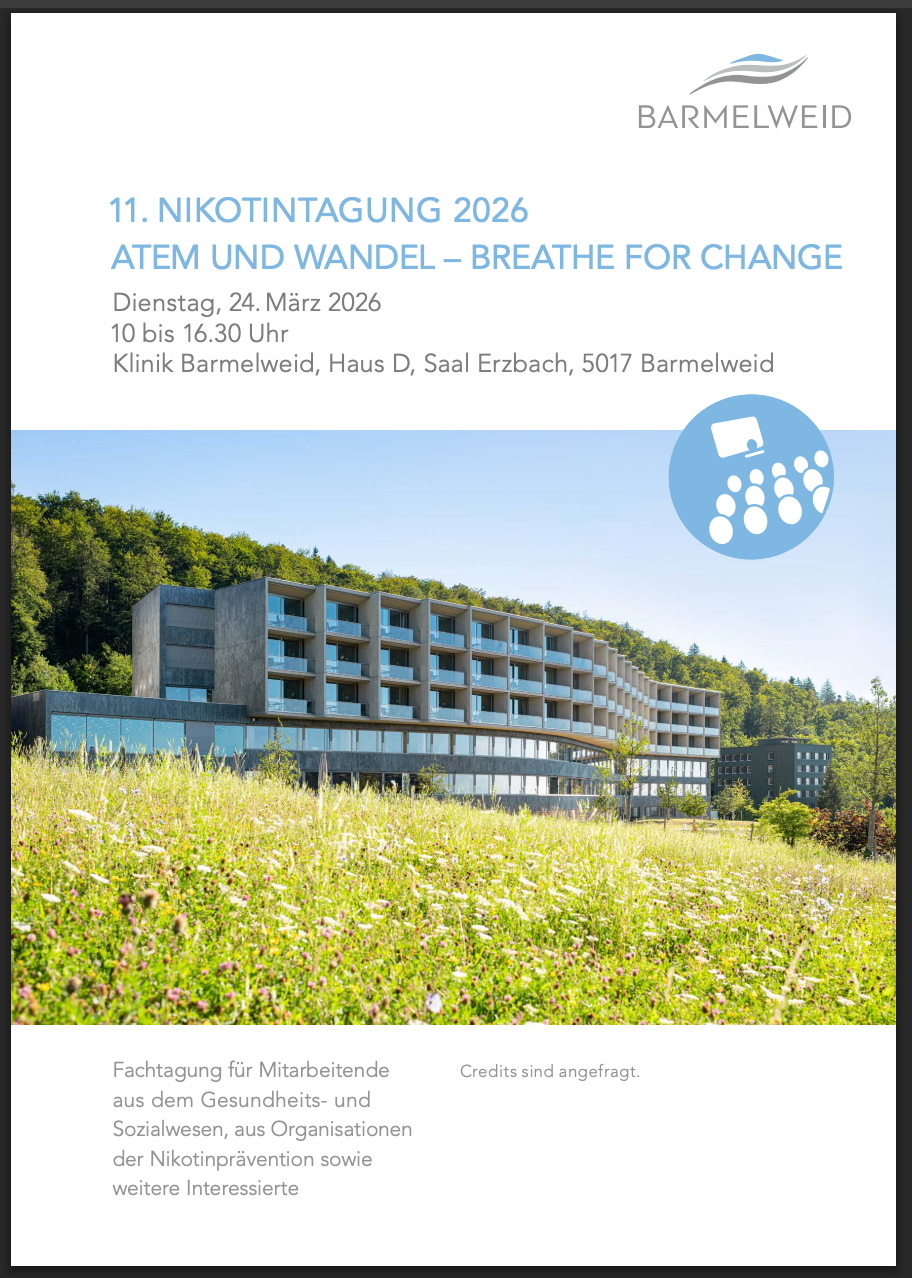
The image of the clinic set against greenery, and the column of seals a few pages later, completed the effect. Before anyone spoke, the event had already been framed through care, order, certification, and authority.¹
The seals mattered. Barmelweid foregrounded its international Gold recognition within the network of tobacco-free healthcare services. At the same time, the network itself described certification not only as a mark of commitment but also as a valuable signal to insurers and referring physicians. The effect was not merely symbolic. Certification did not just affirm a principle; it helped place the institution within a hierarchy of credibility.²
The conference projected public health, certainly. But it also projected standing.
Its organizing core was local. It centered on Klinik Barmelweid, a Swiss specialty and rehabilitation clinic with a strong focus on pulmonology and nicotine-cessation counseling, and on the FNBS, which appeared in the program through Susann Koalick, head of the clinic’s nicotine counseling service and president of the forum. Barmelweid maintained a formal cessation structure; FNBS presented itself as a nonprofit platform supporting institutions and professionals in implementing evidence-based standards for nicotine prevention.¹˜³
A second layer came from transnational legitimation. By opening with José Luis Castro, the WHO Director-General’s Special Envoy for chronic respiratory diseases, and Cornel Radu-Loghin, secretary-general of the ENSP, the meeting placed itself under two established forms of authority: the WHO’s norm-setting role and the European tobacco-control advocacy represented by the ENSP. The conference presented itself not simply as training, but as part of a wider field organized around nicotine control. ¹˜⁸
A third layer came through practical translation. The program spanned oncology, dentistry, child and adolescent psychiatry, cardiology, addiction medicine, occupational health management, work psychology, and digital communication. In that arrangement, nicotine appeared not as a narrow clinical issue but as a cross-cutting problem touching cancer, mental health, youth, workplace culture, and public communication. The session on Rauchfrei-Kultur, featuring hospital managers and human-resources personnel, was especially revealing. The focus shifted from the individual smoker to institutional governance and the production of smoke-free and nicotine-free environments.¹
That shift matters. The conference did not simply ask how to reduce smoking. It also asked who would define the legitimate terms of prevention, which institutions would be recognized as exemplary, and how those standards would circulate.
The most visible interest was preventive and sanitary. The program framed nicotine as a matter of reducing tobacco and nicotine use, protecting young people, integrating cessation into cancer care, cardiology, mental health, and dentistry, and responding to the spread of newer products such as snus, pouches, and electronic cigarettes. But a second interest was also visible: the consolidation of a field. By convening the WHO, the ENSP, hospitals, clinicians, psychologists, prevention specialists, and communication professionals, the organizers were doing more than assembling a conference. They were assembling a network of authority.¹˜⁸
Two sessions made that especially clear: Nikotinindustrie und Sprache and Chancen digitaler Reichweite für Nikotinprävention. The struggle here was not only clinical or regulatory. It was also semantic. The program treated nicotine not simply as a substance to be governed, but as a narrative terrain to be occupied: the language of prevention had to compete with the language of innovation, lifestyle, and harm reduction. In that sense, the event did not merely communicate a position. It also worked to stabilize the vocabulary through which the problem would be understood.¹
The omissions helped define its character. On the publicly listed event page, no industry representatives, vape consumers, harm-reduction associations, or openly dissenting voices were visible. That fact alone does not invalidate the meeting. But it does clarify what kind of meeting it was. This was not a forum designed to test disagreement at its outer edge. It was a forum of alignment.¹

The same logic becomes clearer once one looks beyond the program and into the infrastructure behind it.
The network ran on both money and legitimacy. Revenue came from membership dues, certification fees, training revenue, project-related contributions, and the host clinic’s economic base. Legitimacy came through certification, international recognition, and alignment with cantonal programs and healthcare mandates. Together, those elements produced a more durable kind of standing within the health system: greater authority to speak in the name of prevention, greater value as a reference point, and greater credibility with insurers, referring physicians, and institutional partners.²˜³˜⁵
The clearest starting point is an official record. The 2nd Nikotintagung Klinik Barmelweid received 9,000 Swiss francs from the Swiss Tobacco Prevention Fund between April 2007 and May 2008. The project was framed not as a commercial activity, nor simply as an academic exercise, but as information and awareness-raising and as part of a broader effort in networking and creating favorable conditions for prevention. In the final report, the organizers described the conference as a platform for exchange, a means of expanding knowledge in research and practice, and a way of supporting the implementation of smoke-free measures in hospitals and healthcare institutions. From the beginning, then, the tagung appears less as isolated professional training than as an instrument for organizing a field.⁴
By 2026, that structure no longer looked experimental. The 11th Nikotintagung again placed Barmelweid at the center, with Koalick in a key role, explicit support from the FNBS, and a schedule populated almost entirely by actors from public health, prevention, hospital management, and preventive communication. Registration was set at CHF 300. What appeared in 2008 as a publicly supported effort to build exchange among specialists had, by 2026, become recurring infrastructure: a site where common language, professional visibility, and institutional alignment could be reproduced.¹˜⁴
Its financial base was mixed. The Swiss Tobacco Prevention Fund states that it receives 2.6 rappen per pack of cigarettes sold and disposes of roughly 12 million Swiss francs per year to finance tobacco- and nicotine-prevention measures. Part of this world, in other words, rests on a stable public revenue stream anchored in the very consumption it seeks to reduce.⁴
The statutes of the former FTGS, later renamed FNBS, make the association’s revenue structure explicit: membership fees, certification income, project-related contributions, contributions from the Confederation, cantons, and municipalities, donations, service revenue from activities such as training, and investment income. This was not a body sustained by a single grant. It was built to operate as a platform: part association, part service provider, part intermediary for public and institutional money. Even the membership forms point in that direction. Individual membership costs CHF 80 per year; collective membership requires a CHF 250 entry fee and CHF 450 in annual dues. These are not large sums. But they show that affiliation was not only symbolic. It also generated structure.³
The material center of this arrangement was Klinik Barmelweid itself. In 2024, the clinic reported CHF 80.1 million in total revenue, almost all of it from services and deliveries, including CHF 70.6 million from medical and nursing services. It also held positions on the hospital lists of Aargau, Basel-Landschaft, Basel-Stadt, and Solothurn. That mattered because its place in the system did not rest on reputation alone. It rested on cantonal mandates, payer recognition, and formal insertion into the Swiss healthcare infrastructure.⁵

Certification is where these strands converge most clearly.
FNBS offered three certification levels for healthcare institutions—Bronze, Silver, and Gold—with formal pricing, staged requirements, and periodic recertification. More important than the fees was what the standards covered: leadership, communication, training, identification and support for cessation, tobacco-free environments, workplace health, public engagement, and evaluation. Certification, in this sense, did not merely attest compliance. It organized a model of institutional conduct.⁶
The signets extended that logic into the visual environment. FNBS marketed registered “Smoke Free” and “Smoking Area” signage, linking prevention to signage, space, and institutional design. Prevention, here, was not only advice or counseling. It also took material form as an organizational product.⁶
The strategic value of certification was stated most clearly by the network itself. In an interview on the Barmelweid blog, Susann Koalick described certification as a valuable signal to insurers and referring physicians and as something that strengthened the institution’s standing in other quality-certification processes. Barmelweid likewise emphasized that it had been the first Swiss clinic to receive this international Gold recognition in 2020 and the first to be successfully recertified in 2024. Certification did not, on its own, create the right to bill the mandatory insurance system that still depended on hospital lists and cantonal mandates. But it improved its relative position within the healthcare field. It made the institution more legible, more reputable, and more useful within the circuits of referral, reimbursement, and accreditation.²˜⁵˜⁷
At that point, certification ceased to be a detail and became an instrument.
What emerges from these documents is not a conspiracy, and does not need one. The interest is visible enough without it. Public-health language, public funding, certification, clinical infrastructure, and professional events were not operating separately. They were reinforcing one another. The result was a network able not only to advocate prevention but also to define standards, circulate recognition, organize training, convene aligned actors, and strengthen its own centrality within the field.
What remains unknown matters too. Within the public material reviewed here, there is still no audited breakdown of FNBS revenue by category, no precise weighting of each income stream, no full financing breakdown for the Nikotintagungen, and no complete public map of cantonal contracts and projects linked to the network. Those limits should be stated plainly. But they do not erase the pattern already visible in the available record.
That pattern is straightforward. Public money helped build the network. The network helped produce standards. Standards helped produce certification. Certification helped produce a position.
And position, in this case, had effects. It shaped access to recognition, referrals, institutional trust, and public partnership. It helped define what counted as exemplary practice. It generated recurring services around assessment, recertification, training, and materials. It made the network a more plausible partner for policy implementation and more influential in setting the tone of the debate.⁴˜⁵˜⁶˜⁷
The Swiss Barmelweid/FNBS network did not operate in isolation. It operated within a broader field in which the WHO, the ENSP, and philanthropic actors contributed to the financing, coordination, and dissemination of tobacco-control norms, campaigns, and institutional agendas. But the core mechanism is already visible at a closer range. In Barmelweid, prevention appeared not only as a medical or ethical imperative. It also appeared as a way of building position inside the health system, and of turning that position into further influence.⁸
In that sense, the question is not only what prevention opposes. It is also what prevention organizes, what it rewards, and what kinds of authority it helps reproduce.