Nicotine After the Cigarette
The WHO’s nicotine pouch report exposes the limits of public health built around smoking
The WHO’s latest report on nicotine pouches reveals a challenge greater than regulating a new product: contemporary public health still operates more comfortably in the face of homogeneous threats than in the face of ambiguous technologies, whose meaning depends on the scale of risk, the user being observed, and the product they replace.
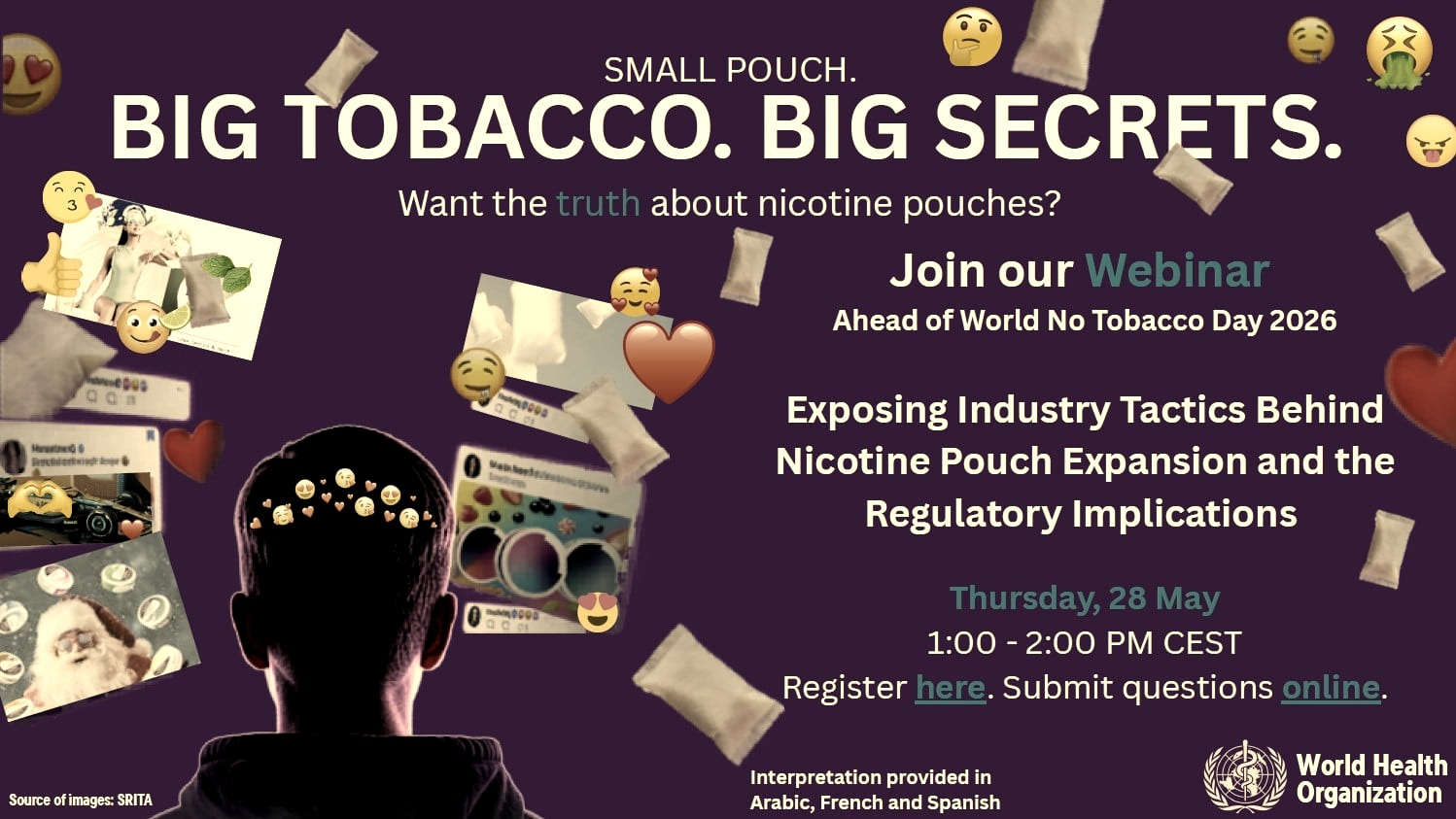
Small, white, almost imperceptible, the nicotine pouch seems designed to escape not only other people’s gaze, but also the classic categories of tobacco control.
It produces no smoke. Leaves no smell. Does not burn. Raises no columns of vapor. Contains no tobacco leaf. Slips beneath the lip. It can be used in silence: in a meeting, on a flight, in a living room.
And yet it carries nicotine — a substance whose public-health meaning changes radically depending on how it is consumed and, above all, on the product it replaces.
For decades, the enemy seemed easy to name. The cigarette condensed dependence, combustion, and death into a single object. Anti-smoking efforts were organized around that clarity. Smoking killed. The consensus was solid because the harm was, too.
Nicotine pouches broke that geometry.
Unlike cigarettes, they deliver nicotine without combustion and, with it, without the primary mechanism that produces most of the toxins associated with smoking. But they do so through devices designed to appear clean, discreet, and compatible with a daily life governed by productivity, mobility, and self-improvement — an aesthetic already familiar from products that promise focus, performance, and balance.
Discretion, pleasure, performance, convenience, and design now come to orbit a molecule historically linked to harm, dependence, and the moral imagination of the cigarette.
It was precisely this ambiguity that led the World Health Organization to sound the alarm. In its report, Exposing Marketing Tactics and Strategies Driving the Global Growth of Nicotine Pouches, published on May 15, the WHO describes a market outpacing the capacity to regulate it. To a large extent, the document reads this phenomenon as a technological update of older tobacco-industry strategies.
Its concern centers on categories that are already familiar: fruit and candy flavors, eye-catching packaging, influencers who replace mass advertising with the continuous intimacy of personalized feeds, sports sponsorships, aspirational branding, and the use of “tobacco-free” language in campaigns that can turn nicotine dependence into a lifestyle aesthetic.
The concern is not imaginary.
In Great Britain, a study by Tattan-Birch, Jackson, Shahab et al. published in The Lancet Public Health estimated that nicotine pouch use among 16-to-24-year-olds rose from 0.7% in January 2022 to 4.0% in March 2025; among men in that age group, it reached 7.5%. But those numbers, on their own, do not fully explain what this growth means. The study shows substantial overlap with smoking and vaping, and it also suggests that some smokers are using pouches in quit attempts. What it does not establish, by itself, is how much of the increase reflects initiation, dual use, temporary experimentation, or partial substitution for cigarettes.
In the United States, data from Han, Harlow, Miech et al. also found that nicotine pouch use among 10th- and 12th-grade students increased from 2023 to 2024, along with a rise in dual use with e-cigarettes. The pattern suggests a shift in the youth nicotine market, but it does not, by itself, establish that this is simply a new epidemic of initiation.
WHO’s warning moves chiefly on the terrain of precaution. Less as a response to conclusive evidence that pouches are creating, on a large scale, a new population of dependent users among non-users, and more as a reaction to the convergence of sensory appeal, discreet use, aspirational marketing, and low risk perception.
The controversy deepens because the disagreement lies not only in the regulatory responses but in the very causal premises of the debate.
Peter Hajek, for example, has questioned the robustness of some claims about permanent nicotine-related damage to the adolescent brain. He argues that many such inferences derive from animal models exposed to doses and conditions only weakly comparable to real human consumption. Researchers such as Lion Shahab and Cristine Delnevo, meanwhile, challenge the causal reading of the so-called gateway effect. For them, the association between trying non-combustible nicotine products and later smoking may reflect less a gateway than a shared predisposition to risk-taking behavior, which part of the literature calls common liability.
Nicotine itself, moreover, is pharmacologically less simple than the public imagination usually allows. That does not make it harmless. But it does make the old equivalence between nicotine, combustion, and harm less stable.
But this is where the debate grows more complicated than the WHO’s precautionary logic seems able to accommodate.
Because the very attributes that may widen experimentation among adolescents — discretion, flavors, the absence of smoke — also appear, for millions of adult smokers, as concrete means of replacing the cigarette.
The same product that may function for some as a gateway can operate for others as a route out.
And perhaps it is precisely this uneasy coexistence that contemporary regulatory systems have not yet learned how to govern.
But perhaps the hardest part of this debate does not lie with adolescents who may begin. That group matters, of course — epidemiologically and ethically. The problem is that contemporary public health has come to focus almost exclusively on those who might start using nicotine, and less and less on those who have never managed to stop.
While governments and international bodies concentrate their energy on containing new forms of initiation, another population remains partly out of frame: millions of smokers who go on consuming combustible cigarettes despite decades of campaigns, tax increases, health warnings, and cessation policies.
For a significant share of these smokers, quitting ceased long ago to be a simple matter of public health information. And those who still smoke today no longer resemble the average smoker of the 1980s or 1990s.
As smoking declined, it also became more concentrated. More and more, it came to settle among socially vulnerable groups: people living with psychological distress, exposed to precarious work, low income, interrupted schooling, social exclusion, and more persistent forms of dependence.
In many countries, smoking has ceased to be a habit evenly distributed across the population and has become, instead, a marker of inequality.
From here on, the discussion of risk shifts scale.
At the individual level, no nicotine-containing product is entirely without risk. No substance introduced into the human body is biologically neutral: dose, frequency, age, clinical condition, and individual vulnerability all matter. And dependence remains dependence.
But from a toxicological point of view, the distance between a nicotine pouch and a combustible cigarette is immense.
The main public-health devastation caused by smoking has never come from nicotine in isolation, but from combustion: tar, carbon monoxide, ultrafine particles, and thousands of compounds generated by burning tobacco.
By that logic, replacing cigarettes with non-combustible products may represent a substantial reduction in harm for persistent smokers.
And it is precisely this difference that creates an important political discomfort.
Public health rarely governs a single kind of risk. It has to decide, all at once, what to do with the harm of a product in itself, with the harm of that product relative to what it may replace, and with the aggregate effects of its circulation in society.
In the case of pouches, those scales do not converge easily.
Absolute risk reminds us that no nicotine product is neutral. Relative risk shows that the toxicological distance between a pouch and a combustible cigarette is enormous. Population risk asks a different question: how many adolescents may initiate use, how many smokers may leave combustion behind, how many will remain dual users, and how many non-users may be drawn into the nicotine market.
The problem is that each of those questions may push public policy in a different direction.
Advocates of harm reduction often point to the Swedish experience as population-level evidence of this shift. In Sweden, where the use of oral nicotine products such as snus has historically replaced a significant portion of cigarette consumption, lung cancer rates and tobacco-related mortality are among the lowest in Europe. Critics respond that highly specific cultural and regulatory contexts make simple generalizations difficult. Even so, the Swedish case remains one of the most uncomfortable facts for regulatory models that tend to treat all forms of nicotine as equivalent in risk.
Part of the difficulty lies, too, in the scale chosen to interpret the phenomenon.
The recent rise of nicotine pouches among adolescents is often narrated in relative terms: it “quadrupled,” it “exploded,” it “advanced rapidly.” And in some specific markets, the expansion has indeed been fast.
But relative growth and population magnitude are not the same thing.
Even in the countries where the increase among young people has most alarmed health authorities, pouches are still circulating at levels far below those historically reached by combustible cigarettes.
And yet the global map of youth tobacco use itself prevents combustion from disappearing from view.
In its Global Report on Trends in Prevalence of Tobacco Use 2000–2030, WHO estimated that 9.7% of adolescents aged 13 to 15 were using tobacco in 2022; in the regional projections through 2030, no region falls below 9%. Even where the rate is lower, as in Africa, it remains around 9.5%; in Europe, it reaches 11.6%.
None of this diminishes the importance of prevention among adolescents. But it does suggest that contemporary nicotine policy may be trying to respond, at the same time, to two distinct phenomena: the massive persistence of combustion and the much more recent, and numerically smaller, emergence of alternative non-combustible products.
The risk, then, is that the symbolic speed of the new may obscure the epidemiological persistence of combustion.
The codes no longer belong to the classic imagery of tobacco: smoke, ashtrays, yellowed stains on the fingers, the smell embedded in clothes.
The new products circulate through a different aesthetic. They come in colorful, seductive packaging, draw on pop culture references, offer flavors that evoke fruit, candy, or energy drinks, spread through digital platforms, and carry with them a constant promise of discretion.
For much of the twentieth century, the tobacco industry sold a sense of belonging through images of masculinity, risk, and rebellion. Now the repertoire has changed. Contemporary consumption rarely presents itself as excess. It prefers the language of balance, efficiency, and self-management.
It is within this landscape that WHO locates its central concern: the possibility that products designed to appear clean, modern, and tobacco-free may lower the symbolic barriers to entry for adolescents and young adults.
What unsettles some public health authorities may not be the presence of nicotine alone, but the possibility that it might once again circulate socially without carrying the full moral iconography of the cigarette.
For a long time, nicotine, harm, combustion, and morality were compressed into a single symbolic entity. Nicotine pouches break that compression.
Contemporary life, after all, already runs on continuous architectures of stimulation. Breakfast arrives calibrated in caffeine. Midday demands focus and output. The afternoon comes in cans of sugar, taurine, and neurochemical marketing. At night, apps turn anxiety into a monthly subscription, while alcohol, melatonin, or anxiolytics artificially reorganize rest.
None of this erases nicotine’s specificity or its physiological potential for dependence. But it does help explain why pouches circulate with relative ease within a cultural ecosystem already accustomed to discrete, continuous, and socially normalized forms of behavioral capture.
Perhaps the contemporary problem lies not only in the existence of these mechanisms of capture, but in the way we decide which of them to treat as moral deviance, and which to absorb, without much alarm, as lifestyle.
The problem begins when attributes such as flavor, discretion, and convenience come to be read almost automatically as signs of youth capture.
These attributes do not carry a fixed epidemiological meaning. For an adolescent who has never smoked, sweet flavors may function as a path to experimentation. For an adult smoker who has consumed a pack a day for twenty years, those same flavors may help break the sensory bond with the cigarette.
It is this ambiguity that unsettles the old categories of tobacco control.
For decades, nicotine, cigarettes, and death could be treated almost as a single moral entity. The dominant harm was concentrated in the combustible cigarette, and any expansion of nicotine use seemed, by definition, threatening.
Pouches break that equivalence. They reduce a substantial part of the harm associated with cigarettes while, at the same time, making dependence more discreet, more palatable, more compatible with the contemporary aesthetic of performance and convenience.
The WHO report itself moves within this frame. In describing pouches as products designed to sustain dependence, and in warning that their commercial strategies may expose a new generation to addiction, the document is not speaking only about toxicology or regulation. It translates the circulation of these products into a moral language of capture, manipulation, and generational threat.
It is here that the report reveals, at once, both its strength and its limit. It is right to identify a sophisticated contemporary grammar of commercial capture. Nothing different from other products. But it stumbles when it tries to govern ambiguous technologies through moral categories forged for far more homogeneous threats.
The report reveals, in the end, that international nicotine policy seems to operate more comfortably in the face of the emerging risk of initiation than in the face of the historical persistence of combustion.
* * *
World Health Organization (2026). Exposing marketing tactics and strategies driving the global growth of nicotine pouches. World Health Organization. https://iris.who.int/handle/10665/385691. License: CC BY-NC-SA 3.0 IGO
Source notes
Public health studies and reports
• Alkharaan, Hassan, Abdulaziz Alrubayyi, Majed Kariri, et al. “Investigating Oral Nicotine Pouch Use Among Adults in Riyadh, Saudi Arabia: Prevalence, Awareness, Susceptibility, and Associated Symptoms.” Frontiers in Public Health 13 (2025): 1607656. https://doi.org/10.3389/fpubh.2025.1607656.
• Conde, Monserrat, K. Tudor, R. Begh, et al. “Electronic Cigarettes and Subsequent Use of Cigarettes in Young People: An Evidence and Gap Map.” Addiction 119, no. 10 (October 2024): 1698–1708. https://doi.org/10.1111/add.16583.
• Dautzenberg, Bertrand, et al. “Systematic Review and Critical Analysis of Longitudinal Studies Assessing Effect of E-Cigarettes on Cigarette Initiation Among Adolescent Never-Smokers.” International Journal of Environmental Research and Public Health 20, no. 20 (2023): 6936. https://doi.org/10.3390/ijerph20206936.
• Delnevo, Cristine D. “E-Cigarette and Cigarette Use Among Youth: Gateway or Common Liability?” JAMA Network Open 6, no. 3 (March 2023): e234890. https://doi.org/10.1001/jamanetworkopen.2023.4890.
• Farsalinos, Konstantinos. “Nicotine Pouches: An Aid in Smoking Cessation, or a New Public Health Hazard?” Internal and Emergency Medicine 21, no. 3 (April 2026): 843–858. https://doi.org/10.1007/s11739-026-04278-1.
• Shahab, Lion, Emma Beard, and Jamie Brown. “Association of Initial E-Cigarette and Other Tobacco Product Use with Subsequent Cigarette Smoking in Adolescents: A Cross-Sectional, Matched Control Study.” Tobacco Control 30 (2021): 212–220.
• Sun, Ruoyan, David Méndez, and Kenneth E. Warner. “Association of Electronic Cigarette Use by US Adolescents With Subsequent Persistent Cigarette Smoking.” JAMA Network Open 6, no. 3 (March 2023): e234885.
Clinical research and neuroscience
• Barreto, George E., Alexander Iarkov, and Valentina Echeverria Moran. “Beneficial Effects of Nicotine, Cotinine and Its Metabolites as Potential Agents for Parkinson’s Disease.” Frontiers in Aging Neuroscience 6 (January 2015): 340.
• Belluardo, Natale, G. Mudò, M. Blum, and K. Fuxe. “Central Nicotinic Receptors, Neurotrophic Factors and Neuroprotection.” Behavioral Brain Research 113, nos. 1–2 (August 2000): 21–34. https://doi.org/10.1016/S0166-4328(00)00197-2.
• Goniewicz, Maciej L. “Biomarkers of Electronic Nicotine Delivery Systems (ENDS) Use.” Addiction Neuroscience 6 (2023): 100077.
• Green, Harry Jacob, et al. “An Exploratory, Randomized, Crossover Study to Investigate the Effect of Nicotine on Cognitive Function in Healthy Adult Smokers Who Use an Electronic Cigarette After a Period of Smoking Abstinence: Study Protocol.” International Journal of Clinical Trials 9, no. 2 (2022): 136–142.
• La Rosa, Giusy Rita Maria, et al. “Self-Reported Oral Health Outcomes After Switching to a Novel Nicotine Pouch Technology: A Pilot Study.” Acta Odontologica Scandinavica (2025). Advance online publication.
• Nop, Olivia, et al. “Nicotine and Cognition in Cognitively Normal Older Adults.” Frontiers in Aging Neuroscience 13 (May 2021): 640674. https://doi.org/10.3389/fnagi.2021.640674.
• Quik, Maryka, Xiomara A. Perez, and Tanuja Bordia. “Nicotine as a Potential Neuroprotective Agent for Parkinson’s Disease.” Movement Disorders 27, no. 8 (2012): 947–957.
• Rezvani, Amir H., and Edward D. Levin. “Cognitive Effects of Nicotine.” Biological Psychiatry 49, no. 3 (2001): 258–267.
• Spasova, Violeta, et al. “Impact of Nicotine on Cognition in Patients With Schizophrenia: A Narrative Review.” Cureus 14, no. 4 (April 2022): e24576.
Market analysis and behavior
• Fearon, Ian M., et al. “Curiosity and Intentions to Use Myblu E-Cigarettes and an Examination of the ‘Gateway’ Theory.” Drug Testing and Analysis 15, no. 10 (October 2023): 1252–1261.
• Minton, Michelle. “Perverse Psychology.” Competitive Enterprise Institute, January 2020.
• Russell, Christopher, Willie J. McKinney, and Ian M. Fearon. “Behavioral Intentions Assessment of a Disposable E-Cigarette Among Adult Current, Former, and Non-Smokers in the United States.” Drug Testing and Analysis 15, no. 10 (October 2023).
• Warner, Kenneth E., and David Méndez. “E-Cigarettes: Comparing the Possible Risks of Increasing Smoking Initiation With the Potential Benefits of Increasing Smoking Cessation.” Nicotine & Tobacco Research 21, no. 1 (2019): 41–47. https://doi.org/10.1093/ntr/nty062.
Conferences, talks, and other documents
• Benowitz, Neal L. “Nicotine Addiction: From Biology to Regulatory Policy.” Presentation at the CAsToR Symposium, May 17, 2023.
• Newhouse, Paul A. “Long-Term Transdermal Nicotine for the Treatment of Mild Cognitive Impairment.” Vanderbilt Center for Cognitive Medicine / Vanderbilt University Medical Center, talk/interview, 2022.
• Yang, Zhongli, and Ming D. Li. “Effects of Tobacco on Feeding and Energy Homeostasis.” Unverified institutional citation; likely a chapter, lecture, or review rather than a standalone journal article.