The deadliest nicotine product ever invented remains legal, visible, and routine. It is there in convenience stores, in the crumpled packs carried in a pocket, in the break during the workday, on the corner, in the habit itself. Almost everywhere, the combustible cigarette remains so readily available that its chemical violence nearly dissolves into the landscape.
The paradox requires no rhetoric. Around it, however, the language of prudence shifts in tone. Nicotine products that are substantially less dangerous, though backed by different kinds and degrees of evidence, such as vapes, snus, nicotine pouches, and heated tobacco, circulate in many countries under a regime of suspicion denser than the one reserved for the cigarette itself. In some places, they are banned. In others, they are tolerated grudgingly, hemmed in by restrictions or described in a public language that treats gradations of risk as though they were morally intolerable concessions.
This is where the Global Forum on Nicotine stops seeming like merely a niche conference. Since 2014, the gathering in Warsaw has become one of the clearest places in which this contradiction is examined without the easy protection of ready-made formulas. Researchers, physicians, regulators, consumers, industry representatives, web activists and harm-reduction advocates come together there not as a harmonious community but as a dissonant assembly, drawn by an impasse the global debate has yet to face with much honesty: how to lessen the deadly burden of smoking in a field where, for many institutions, distinguishing degrees of risk remains more uncomfortable than pretending they do not exist.
The question begins, in part, with Gerry Stimson, the British public-health social scientist and one of the defining figures in the history of harm reduction. In 2013, after years of watching part of the European debate treat tobacco and nicotine as though they belonged to the same moral order, Stimson arrived at a diagnosis almost too plain to be palatable: public health was failing to distinguish between what creates dependence and what, in combustion, causes death.
“We have known for a long time that people smoke for nicotine and die from the gases and tar.”
The line, which Stimson brought back at the Forum’s first gathering, needed no embellishment. It revealed a fault line. On one side stood the possibility of thinking in terms of relative risk, harm reduction, and regulatory innovation, without treating every nicotine product as if it were the burning cigarette. On the other stood a stubborn public grammar in which nicotine, combustion, and harm are still fused into the same condemnation.
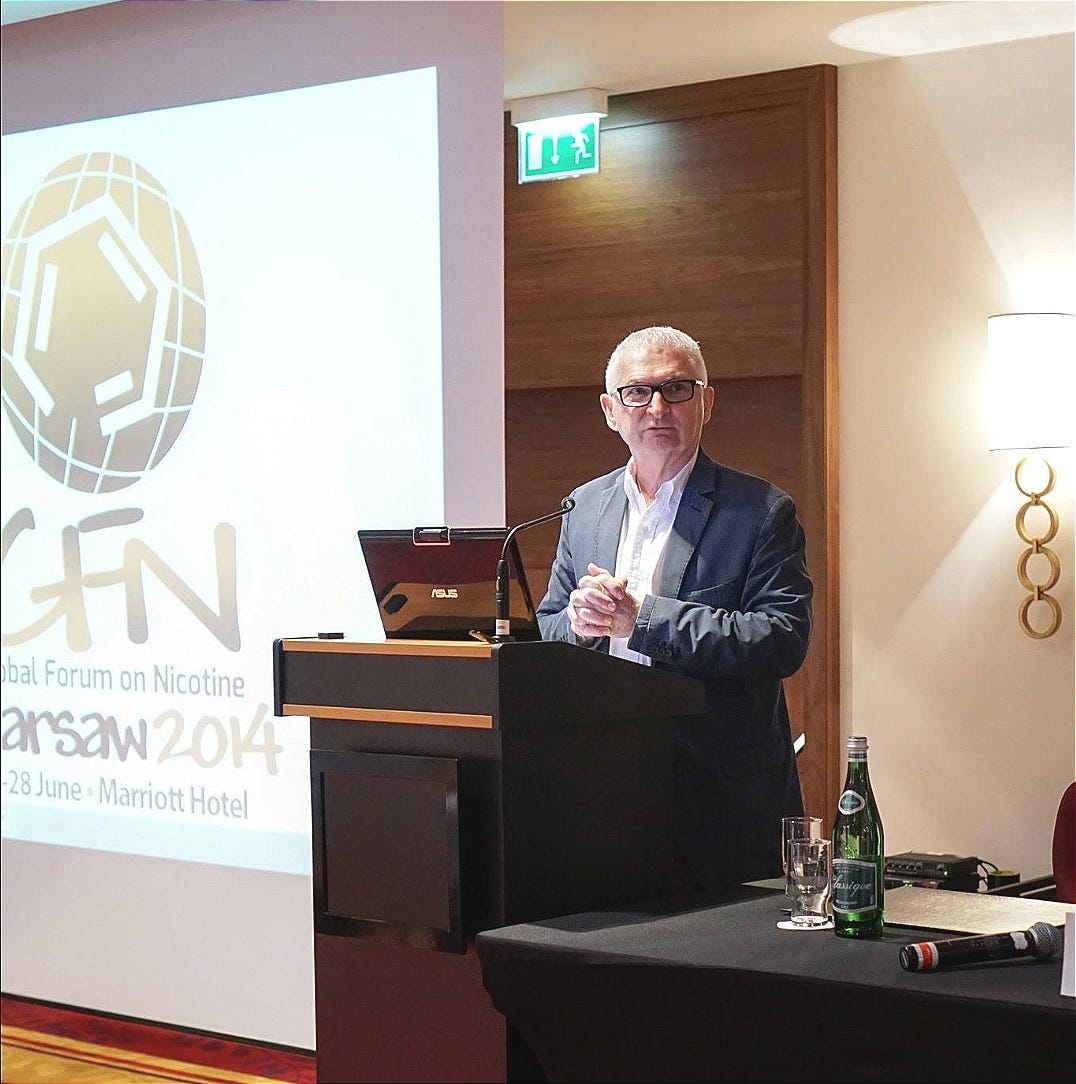
From that fracture came the first Global Forum on Nicotine, held in Warsaw in June of 2014, with support from collaborators including Paddy Costall and Andrzej Sobczak. Some 220 participants from 26 countries attended the first gathering. The meeting was small. The problem was not. The Forum’s purpose was already clear: to create a space in which that distinction could be examined before it was moralized, flattened, or consigned to silence.
Since then, the GFN has become something more than an annual conference. It has served as a seismograph for the tensions reshaping the debate over nicotine, smoking, and harm reduction. With each edition, what returns is not simply a new theme but the same conflict particles in altered form: between evidence and orthodoxy, between the lived experience of people who smoke and the institutional languages that presume to speak for them, between the possibility of reducing harm and the persistent temptation to treat nuance itself as a form of weakness.
Over the years, the GFN began to take shape as a kind of recurring map of the tensions, shifts, and impasses reorganizing the debate over nicotine and smoking. Each edition captured less an isolated theme than the momentary state of a larger dispute.
In 2015, the dispute came into sharper focus. With “A Different Kind of Endgame” as its theme, the Forum began asking not only how smoking might end but also what sort of ending was being imagined. For years, the prevailing assumption had been that the cigarette would be defeated chiefly by ratcheting up pressure on people who smoke and on the industry. What the GFN began to frame more clearly at that point was another possibility: that lower-risk nicotine products might speed the cigarette’s decline by a route many still resisted recognizing, especially within public health itself.
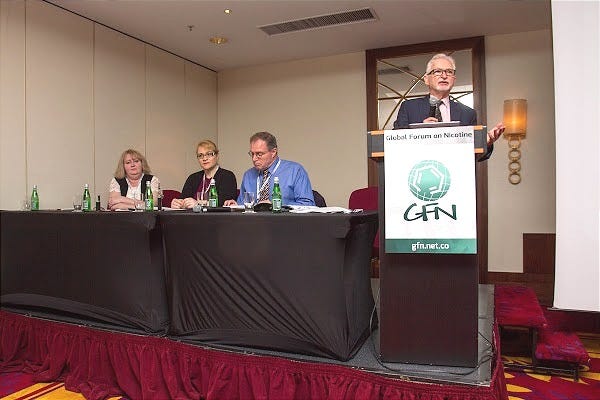
The opening of the conference already made clear the axis of that shift. In the Michael Russell Oration, Derek Yach warned that the WHO Framework Convention on Tobacco Control would need a radical shift in emphasis to remain relevant. The point was straightforward: separating nicotine from tobacco-control policy was no longer some marginal provocation; it was becoming a precondition for thinking about the end of the cigarette itself without the usual rhetorical reflexes. By 2015, the GFN was beginning to show that the dispute was not just about products. It was about who would claim the authority to define the public-health horizon of the endgame.
By 2016, the ground was already beginning to shift. Under the banner Evidence, Accountability and Transparency, the Forum addressed a fast-changing landscape in which new nicotine-delivery systems were advancing faster than institutions could assess them without reverting to habit. The problem was no longer simply the arrival of new products, but the asymmetry between the speed of innovation and the slowness and, in some cases, the reluctance of regulatory response. In that setting, transparency and accountability referred not only to the data themselves. They also referred to the institutional and personal positions through which those data were being interpreted.
In his opening remarks, David Sweanor summed up the scale of the dispute: hundreds of millions of lives were at stake, along with hundreds of billions of dollars and the reputations of entire groups and individuals, all of it unfolding in an environment saturated with beliefs that were at once deeply entrenched and badly misinformed.
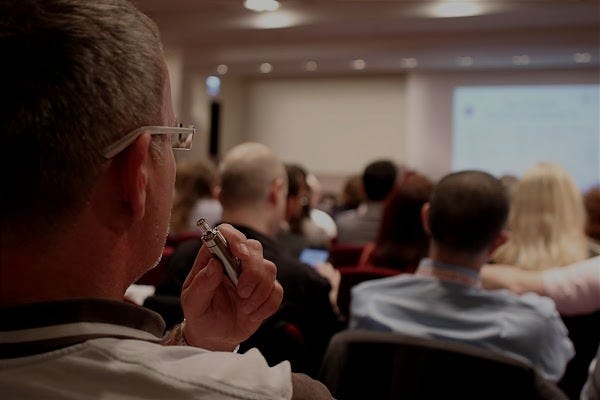
That year, the GFN was beginning to show that the debate over nicotine would be fought not only over evidence, but over who could be trusted to interpret it honestly and to expose, without pretense, the interests bound up in it. The European premiere of Aaron Biebert’s A Billion Lives pushed that shift further: the conflict was no longer calling only for regulation. It was also calling for a narrative.
By 2017, the Forum was speaking more plainly. With the theme Reducing Harm, Saving Lives, a sharper conviction was coming into view: ignoring lower-risk alternatives was not a way of preserving neutrality, but a way of consenting, through omission, to avoidable harm. As the science advanced and the regulatory landscape shifted by degrees, it became harder to keep treating harm reduction as a marginal hypothesis or a rhetorical concession. What was at stake was beginning to be stated with greater candor: if products less dangerous than the combustible cigarette exist, then rejecting them outright is also a choice, and one with a human cost.
That year’s Michael Russell Oration carried the shift further by another path. In “Drug Control and Tobacco Control: Parallels, Reform and Advocacy,” Ethan Nadelmann suggested that the debate over smoking had something to learn from the history of drug policy, particularly from the repeated failure of models that leave consumers out of the process and confuse protection with tutelage.
The first edition of the International Symposium on Nicotine Technology (ISoNTech), brought into the Forum that same year, extended the movement: the dispute was no longer only regulatory or epidemiological. It was also lodged in the material reality of innovation—the devices, their engineering, their evolution—and in the way technology might, in practice, reconfigure the possibilities of moving away from the cigarette.
With each edition, the same dissonance reappeared in a different form. On one side was a growing body of data, studies, successful regulatory experience, and testimony from consumers who had shifted away from cigarettes using noncombustible products. On the other hand, there was the persistence of a political culture hostile to nuance, in which distinguishing degrees of risk seemed more dangerous than preserving a single moral pedagogy.
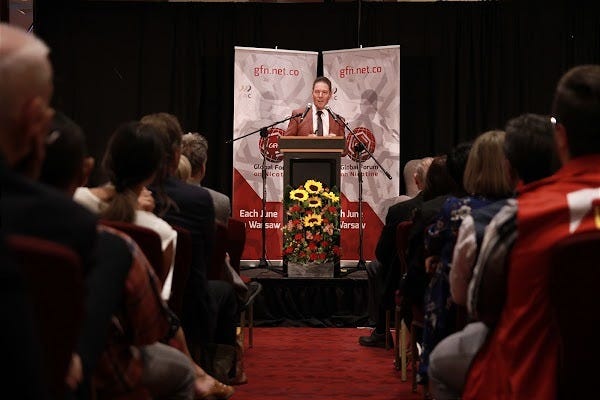
By 2018, under the banner Rethinking Nicotine, the Forum was no longer arguing only about how to interpret the evidence, but about the very language in which the debate was conducted. The point was to rethink nicotine’s place in public health without falling back, by force of habit, on the inherited grammar of tobacco control as if every form of use had to bear, untouched, the cigarette’s historical guilt.
The growing presence of consumers, the creation of the Michael Russell Award, presented to Lars Ramström, and the launch of the Tobacco Harm Reduction Film Festival all suggested that the field was widening: it was no longer enough simply to produce data; it was necessary to contest the images, symbols, and narratives through which those data would be made legible.
In 2019, the forum returns under the theme “It’s Time to Talk About Nicotine.” It was no longer just a matter of rethinking nicotine, but of bringing it out of the regime of silence, discomfort, and simplification that public debate had built around it.
To talk about nicotine, in that context, was to reopen distinctions that much of the language of public health had learned to suppress: between the cigarette and nicotine, between combustion and consumption, between the ideal of abstinence and the possible reduction of harm.
It was meant to compel public health to recover a language capable of recognizing degrees of difference. And, with them, differences in fate.
The growing interest in that shift was already evident in the scale of the gathering: nearly 600 participants came to Warsaw that year, a significant increase over previous editions.
In accepting the Michael Russell Award, David Abrams distilled one of the crucial points the Forum had been trying to restore to the center of the debate: the issue was not only one of product, risk, or regulation, but whether people trying, in concrete ways, to change their relationship to nicotine would be met with acceptance, understanding, and compassion. “It’s about the people, the people and the people,” he said.
By 2019, the GFN was showing that the dispute over nicotine was not only about toxicology or policy. It was also about the moral imagination through which public health chooses to regard people who smoke.
Then the pandemic arrived, and with it a new kind of test.
In 2020, like nearly every international gathering, the GFN was pushed online. In its case, though, the shift did not reduce it to a digital replica. In some respects, it enlarged it. The need to build its own broadcast platform enabled the Forum to reach more people, launch GFN TV, and give its debate ecosystem a more continuous and visible form.
That year’s edition, with more than two thousand participants from over a hundred countries, made plain what had been visible for some time: the discussion around nicotine and tobacco was not only scientific or regulatory. It was also ethical, political, and deeply bound up with the language of rights and the everyday lives of ordinary people.
In a year defined by the theme “Nicotine: Science, Ethics and Human Rights,” the meeting brought together more than thirty speakers over two days to examine not only the growing body of evidence in favor of harm reduction but also the intensifying attacks on researchers, academics, and professionals associated with the field.
Entire organizations were being discredited; real or alleged ties were used as a mechanism of disqualification; and public debate seemed increasingly willing to descend into ad hominem attack.
It was in that atmosphere, saturated with fear, misinformation, and narrative struggle, that issues such as the lung-injury crisis known as EVALI took on particular weight, along with its mistaken attribution to nicotine vaping rather than to illicit THC products, the moral panic around youth use, and the influence of major philanthropists on the language and priorities of public health.
By 2020, the GFN was showing that the conflict no longer turned only on disputes over the evidence. It also turned on the very conditions that made debate possible.
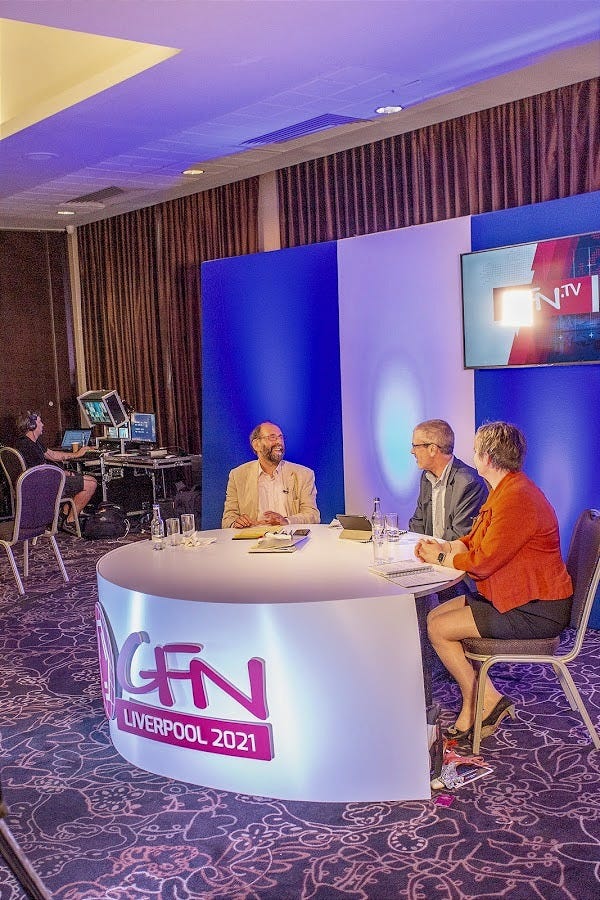
In 2021, still under the shadow of the pandemic, the GFN began to press a question that carried the debate beyond the immediate crisis: what is the future of nicotine?
The formulation sounds abstract only at a distance. Up close, it drags behind it questions of science and investment, global inequality and consumer behavior, regulatory capacity and control policy, and at the center of it all, the persistent friction between orthodoxy and innovation.
Organized around The Future for Nicotine, that year’s program examined both the advances already visible in the world of lower-risk products and the often abrasive relationship between science and policy, the impact of technological innovation on public health, and the repeated failure of international bodies to hasten the end of the cigarette.
The Forum had not yet fully returned to an in-person format. The 2021 edition adopted a hybrid model, with a small core of speakers and attendees on site and broader participation online.
But that constraint revealed something else: the GFN was no longer functioning only as a gathering but as a platform for mediation, commentary, and archiving.
The creation of the GFN Commentary Team and the introduction of #GFNFives, which replaced academic posters with short videos submitted by participants, pointed to that change in scale.
By 2021, the Forum was making it clearer still that the dispute over nicotine would not be decided solely by the production of evidence or the drafting of rules. It would also depend on who managed to interpret, translate, and circulate that evidence in an increasingly fragmented public sphere.
When the Forum returned to Warsaw in person in 2022, it no longer made sense to think of it as merely an annual conference. The GFN had become an infrastructure for debate: a machine for producing, recording, translating, and circulating controversy.
The hybrid format, the broadcasts, the #GFNFives shorts, the GFN TV commentary, and the simultaneous translation expanded the Forum’s reach and altered its nature. What was at stake was no longer simply bringing people together in one city, but creating the conditions for certain ideas to travel beyond the room, cross borders, and remain open to public scrutiny. In a field so shaped by caricature, silencing, denial, and moral simplification, that was no mere technical detail. It was a form of intellectual intervention.
That year’s program gave real substance to the shift in scale. The Forum confronted misinformation around harm reduction head-on, examined the role of philanthropy in the field, returned to the uncomfortable question of the Framework Convention’s failure to bring smoking down in any meaningful way, debated the transformation of the industry without the usual comfort of ready-made formulas, and insisted that the problem was not exhausted by vaping, but pointed instead to an entire continuum of risk and displacement away from the combustible cigarette.
Other questions were also returning, now in sharper outline, questions that would no longer be marginal from that point forward: academic freedom in the field of tobacco control, and the question of whether regulation was actually helping to reduce smoking or simply narrowing the alternatives available.
The Michael Russell Award, given that year to Brad Rodu in recognition of more than two decades of research and advocacy for access to safer products, confirmed the sense that the GFN was no longer content merely to observe the dispute. It was becoming more and more one of the places where that dispute found language, contour, and public force.
The Forum’s tenth edition, in 2023, offered a rare chance to look back on its own trajectory without succumbing to self-congratulation.
A decade after its debut, the GFN could credibly claim a singular place in shaping the global debate over tobacco harm reduction. Over those years, it had helped draw researchers and advocates closer to one another, as well as regulators and consumers, voices from the Global South, and academic circuits still caught in the North’s gravitational field.
Above all, it had preserved a space for substantive disagreement, something that, in an age of performed polarization, had become not just rare but structurally at risk.
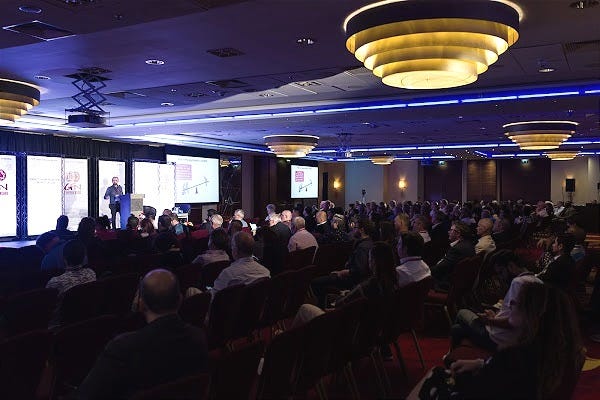
The anniversary, though, hardly warranted any naïve celebration. On one hand, the global use of vapes, snus, heated-tobacco products, and nicotine pouches continued to grow, as tens of millions of people sought out less risky alternatives. On the other hand, a persistent fog of regulatory and political confusion remained capable of blunting part of that movement.
The tenth edition unfolded in the shadow of a harder question: what happens when public uptake outpaces institutional imagination? The approach of the Framework Convention’s COP10, held later that same year in Panama, brought that tension into sharper relief.
In response, the GFN sought to broaden not only the debate itself, but also access to it. Alongside free streaming, live and on demand, came simultaneous interpretation into other languages, initially Spanish and Russian, and a more deliberate effort to open the space to people who had long orbited the debate without ever quite entering it.
The Michael Russell Oration, delivered by Professor Roberto Sussman and devoted to a rigorous critical assessment of the science around tobacco and nicotine, neatly captured the spirit of that moment: ten years on, the question was no longer simply how to produce more evidence, but who gets to interpret it, within what frame, and in service of what kind of future.
By 2023, the GFN was showing that it was no longer peripheral. It had become a force in the debate.
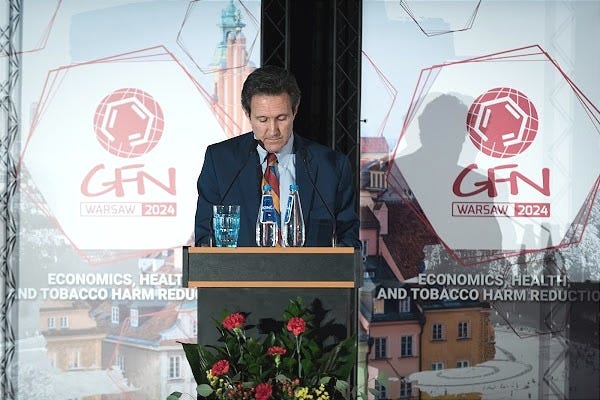
In 2024, under the banner Economics, Health and Tobacco Harm Reduction, the Forum pushed to the center a dimension that had long shaped the debate but had seldom been acknowledged as its organizing core: economics.
It was no longer enough to argue over evidence, relative risk, or regulatory design. The harder question was what it costs—in lives, money, and historical time—to regulate badly, or to prohibit, alternatives less dangerous than the combustible cigarette.
At that point, harm reduction had ceased to be merely a public-health or moral controversy. It was also revealing itself as a dispute over prices, access, taxation, incentives, and technological innovation. To talk about health without talking about political economy was to remain on the surface of the problem.
That year’s program made the point hard to ignore. What are the effects of overly restrictive regulation? Is it possible to quantify the health-care savings associated with the availability of safer products? Does the decline in tobacco-tax revenue, or the state’s dependence on that revenue, shape the regulation of alternatives? And to what extent do badly calibrated rules drive independent manufacturers out of the market and discourage the shift away from combustion?
The presence of figures such as Professor Andrzej Fal and the analyst Vivien Azer gave substance to that widening of perspective. The introduction of #ScienceLab, meanwhile, reinforced the effort to bring emerging research closer to public debate.
And the Michael Russell Oration, delivered by Cliff Douglas and centered on global action to end smoking, helped distill the impasse of that moment: the future of the combustible cigarette would no longer be decided only in the laboratory or the regulator’s office, but also on a less visible, and often less openly acknowledged terrain: that of markets and their asymmetries.
By 2025, the banner Challenging Perceptions: Effective Communication for Tobacco Harm Reduction read like a diagnosis of the times. The dispute was no longer unfolding only on the level of evidence, but in the realm of its public circulation, in whether it reaches people, or fails to reach them at a moment when journalistic rigor was losing its central place and social media, platforms, and the attention economy were beginning to shape collective perception through simplification, moral panic, and low-resolution truths.
Challenging perceptions had become the central task. Not because the science offered easy answers, but because the public sphere seemed less and less willing to tolerate nuance, context, and contradiction.
The paradox could no longer be dismissed as noise: as the scientific case for harm reduction grew more substantial, its public reception, in many places, was becoming murkier. Lower-risk nicotine products continued to erode the cigarette’s centrality. But that movement was advancing in an atmosphere of caricature, suspicion, and simplification that could delay, if not altogether block, the translation into policy.
That was the point at which communication ceased to be merely an adjunct to science. It became part of the conflict itself. It was no longer enough to produce evidence; it was necessary to contest the frame, correct enduring distortions, and ask who was still being left out of the conversation.
In an environment where discourse itself is an instrument of power, perception functions as a regulatory field, and institutional caution can serve as an alibi for inertia, the problem came to lie less in the absence of data than in the difficulty of making those data legible before they were immediately absorbed by the machinery of moral panic.
The choice of Fiona Patten for the Michael Russell Award distilled the spirit of that year with unusual clarity. An Australian politician, consumer, and longtime advocate of harm reduction, she brought together in a single figure lived experience, regulatory conflict, and the public struggle over language. By 2025, the GFN showed that the battle was no longer fought only over what science knows, but over what a society allows itself to hear.
That may be why the GFN provokes such strong reactions: the Forum inhabits a particularly uncomfortable corner of contemporary debate, where scientific evidence, lived experience, industrial interest, regulatory calculation, and moral judgment intersect without ever settling into ease.
Its critics surround it with suspicion; its defenders treat it as an indispensable space. In opposing registers, both recognize the same fact: the GFN is not peripheral. It carries weight in the debate.
It carries weight because smoking remains among the leading preventable causes of death in the world. It carries weight because millions of people continue to smoke not in the abstractions of the laboratory, but in lives marked by inequality, habit, pleasure, dependence, misinformation, and precarious access to alternatives. It carries weight because policies that fail to recognize relative risk can end up protecting the combustible cigarette in the name of regulatory purity. And above all, it carries weight because when public health loses its sense of nuance, it begins to drift away from the very people it most needs to reach.
With 2026 now underway, the trajectory of the GFN reads less like the history of a conference than like the portrait of a larger dispute. Since 2014, the Forum has returned, year after year, to a question that global policy still has not managed to resolve: what, exactly, is being protected when the deadliest product remains available while significantly less harmful alternatives are treated as a threat?
That is the question the thirteenth edition, under the banner Prohibition and Public Health, places once again at the center. Not as a doctrinal abstraction, but as a material, regulatory, and moral problem. If the combustible cigarette remains legal and widely accessible, why do successive waves of prohibition fall on lower-risk products across much of the world?
By insisting on that paradox, the GFN shifts the debate from the object to the logic that organizes it: examining how policies formulated in the name of protection can end up preserving, and even encouraging, exactly the harm they claim to want to reduce.
That might be the Forum’s strength: offering a space where facts can be examined with complexity before being overtaken by rhetoric. The question isn’t whether every alternative should be celebrated, but whether current policies, discourses, and mentalities accurately differentiate among products, use contexts, and actual risks. At that point, the GFN helps move the debate from the doctrinal to the public sphere.

* Photos: GFN/Gerry Stimson